ChaCha20-Poly1305 and Nonce reuse attack
Background
When doing picoCTF 2025, I encountered a challenge that requires to forge a TAG for a AEAD cipher ChaCha20-Poly1305 with a reused key and nonce. This post is a summary of the cipher and the attack.
ChaCha20-Poly1305
Like AES-GCM, ChaCha20-Poly1305 have two components: a encryption cipher and a tag generation part.
ChaCha20
ChaCha20 can be understood as a 20 rounds (80 quarter rounds) variant of ChaCha cipher - a stream cipher. It takes a 256-bit key, a 96-bit nonce, and a 32-bit counter to generate a keystream. The keystream is then xored with the plaintext to produce the ciphertext.
Internal
Quarter Round is the basic of Chacha cipher, which operate on 4 32-bit unsigned integers as follows, and denote as QUARTERROUND(a,b,c,d)
   a += b; d ^= a; d = d << 16;
   c += d; b ^= c; b = b << 12;
   a += b; d ^= a; d = d << 8;
   c += d; b ^= c; b = b << 7;
A state of ChaCha20 can be represented as 4x4 matrix of 32-bit unsigned integers.
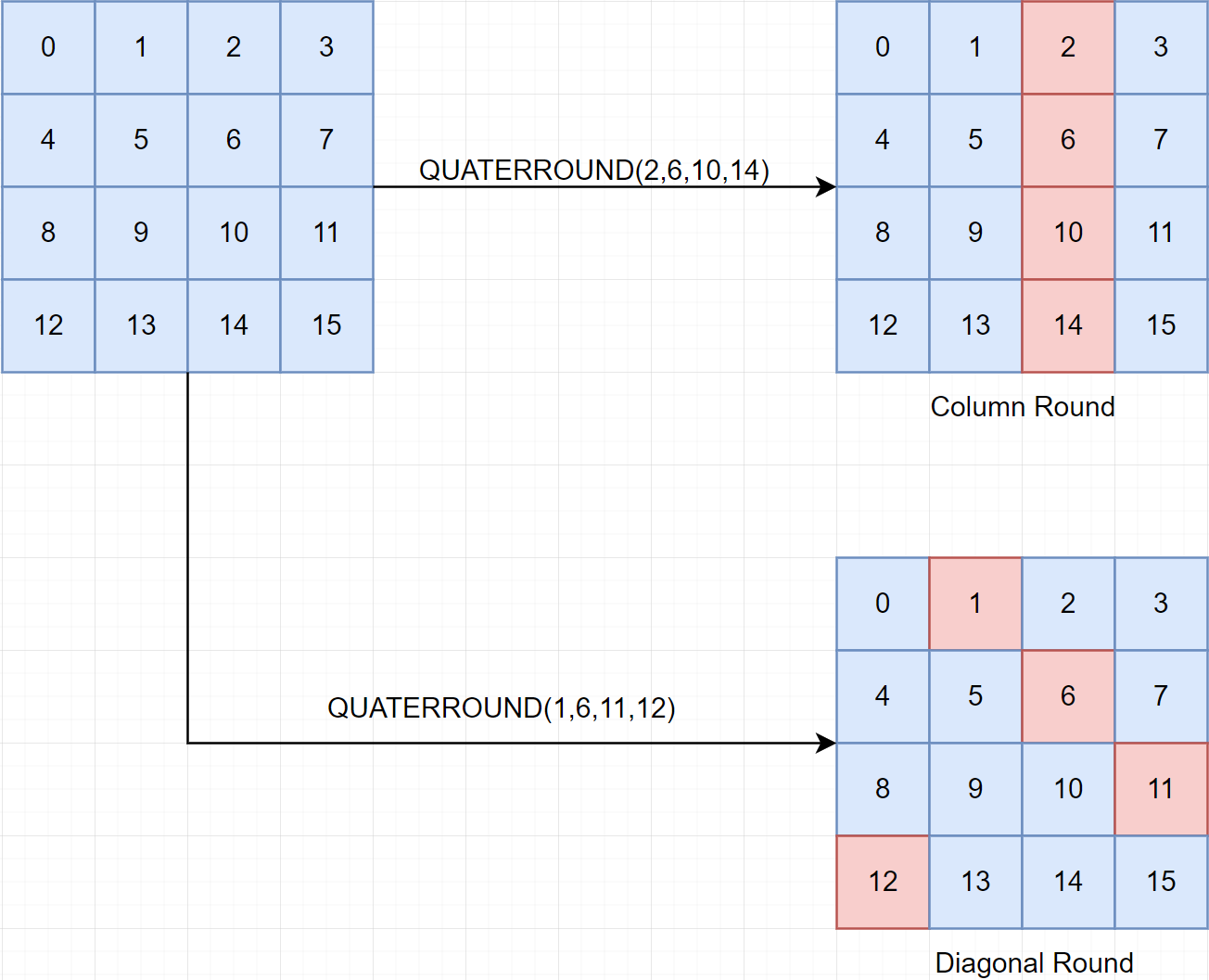
ChaCha20 runs 20 rounds with alternating between column rounds and diagonal rounds. Below present of 2 rounds. So it will run 10 iterations for the list of rounds below.
   inner_block (state):
      QUARTERROUND(state, 0, 4, 8,12)
      QUARTERROUND(state, 1, 5, 9,13)
      QUARTERROUND(state, 2, 6,10,14)
      QUARTERROUND(state, 3, 7,11,15)
      QUARTERROUND(state, 0, 5,10,15)
      QUARTERROUND(state, 1, 6,11,12)
      QUARTERROUND(state, 2, 7, 8,13)
      QUARTERROUND(state, 3, 4, 9,14)
   end

   chacha20_block(key, counter, nonce):
      state = constants | key | counter | nonce
      working_state = state
      for i=1 upto 10
         inner_block(working_state)
         end
      state += working_state
      return serialize(state)
   end
Encryption
Because ChaCha20 is a stream cipher decryption is the same as encryption.
- Input:
- Key: 256-bit key.
- Nonce: 96-bit nonce.
- Counter : 32-bit counter. In ChaCha20-Poly1305, the counter is set to 1 because block 0 is used to derive for Poly1305.
- Plaintext: arbitrary length plaintext.
- Output:
- Ciphertext: same length as plaintext.
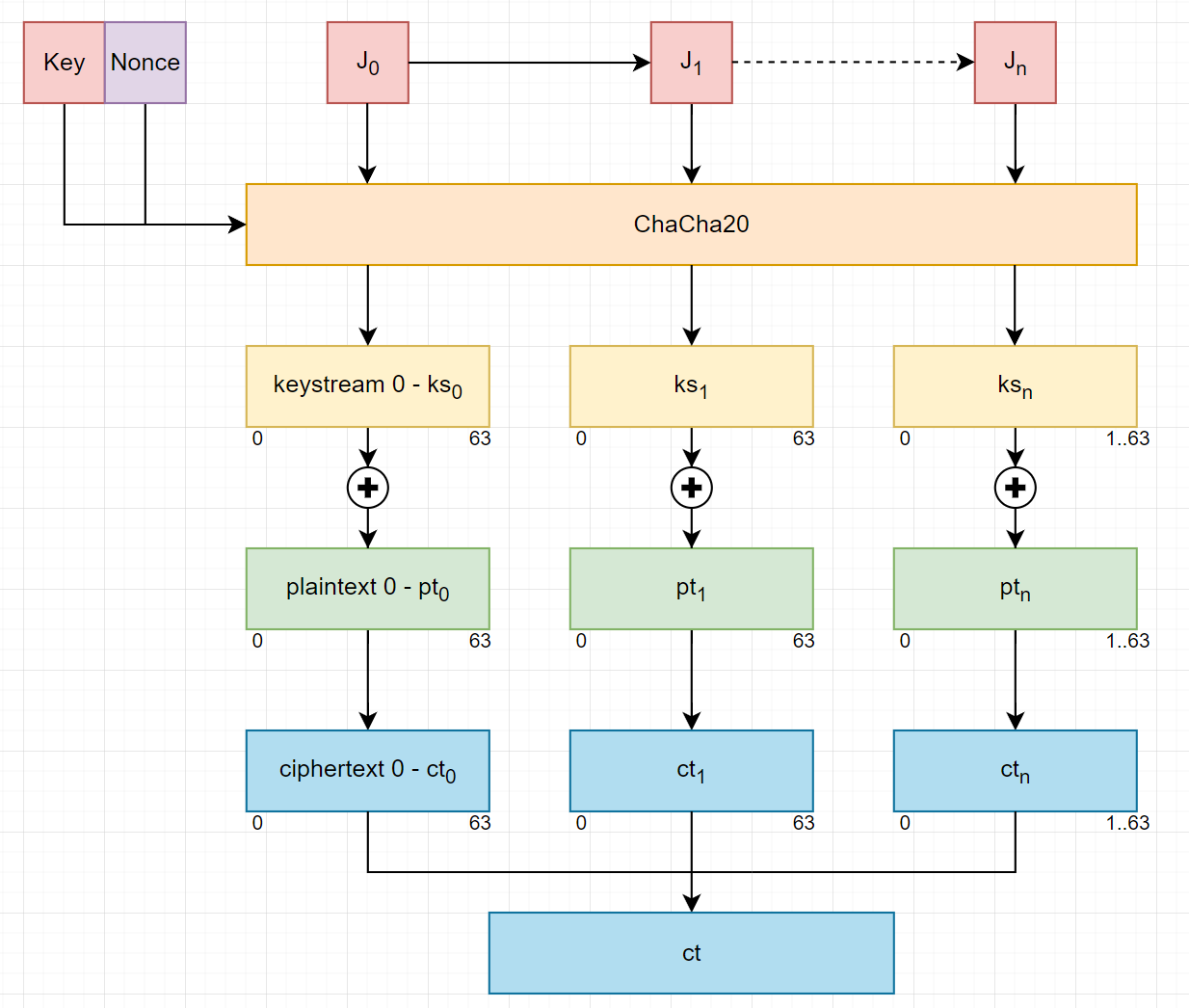
Note: all number in figure are for (0 .. 63) bytes = 512 bits.
- In pesudo code:
   chacha20_encrypt(key, counter, nonce, plaintext):
      for j = 0 upto floor(len(plaintext)/64)-1
         key_stream = chacha20_block(key, counter+j, nonce)
         block = plaintext[(j*64)..(j*64+63)]
         encrypted_message +=  block ^ key_stream
         end
      if ((len(plaintext) % 64) != 0)
         j = floor(len(plaintext)/64)
         key_stream = chacha20_block(key, counter+j, nonce)
         block = plaintext[(j*64)..len(plaintext)-1]
         encrypted_message += (block^key_stream)[0..len(plaintext)%64]
         end
      return encrypted_message
      end
Poly1305
The original Poly1305 first appear in The Poly1305-AES message-authentication code. Briefly, It a MAC function requires 2 128-bits keys, and 1 128-bits nonce. AES used 1 key to encrypt nonce and compile with another key to have a pair .
The pair must be unpredictable and follow the standard below. Here is treated as 16-octet little-endian number because of limitation.
-
r[3], r[7], r[11], and r[15] are required to have their top four bits clear (be smaller than 16)
-
r[4], r[8], and r[12] are required to have their bottom two bits clear (be divisible by 4)
And the Poly1305 function is as follow, because when going into poly1305 have been padded to a multiple of 16 bytes so we don't consider last block < 16 bytes.
def poly1305(r,s,msg):
    def clamp(r):
        r &= 0x0ffffffc0ffffffc0ffffffc0fffffff
        return r
    a = 0
    r = clamp(r)
    p = (1<<130)-5
    for i in range(0,len(msg),16):
        block = msg[i:i+16]
        assert len(block) == 16
        n = le_bytes_to_num(block + b'\x01')
        a+=n
        a = (r*a)%p
    a+=s
    return (a % (1 << 128)).to_bytes(16,'little')
So the Poly1305 function can be written as
pair generation for ChaCha20 is simple as follow.
def poly1305_key_gen(key,nonce):
    cipher  = ChaCha20.new(key=key, nonce=nonce)
    ks = cipher.encrypt(b'\x00'*32)
    return ks[:16],ks[16:] #(r,s) in bytes -> need to convert to le int
ChaCha20-Poly1305 encryption/decryption.
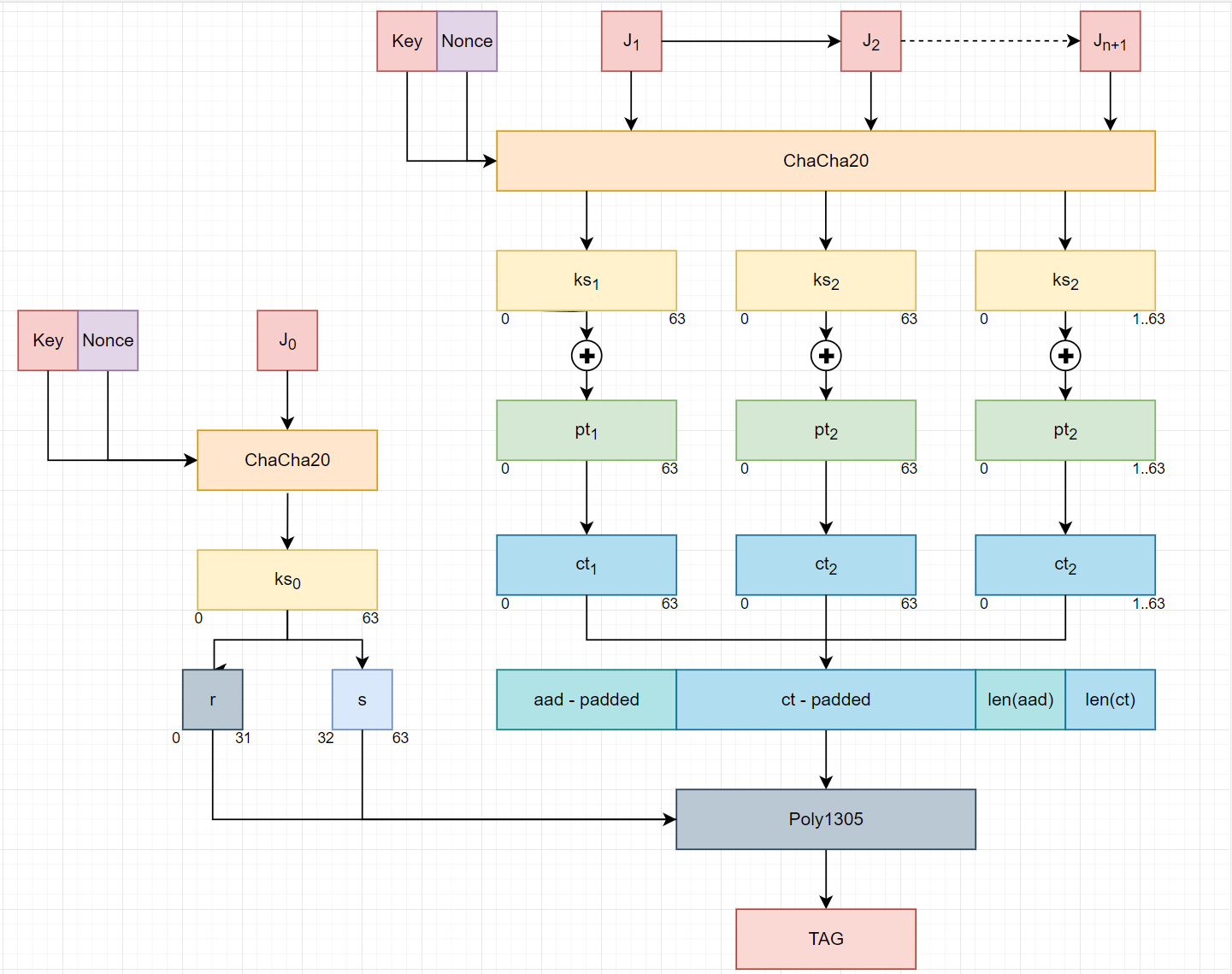
Here is sanity check script.
Reuse Nonce attack:
In Oracle scheme, The key is often reused for multiple messages, but when Nonce is reused, we will have 2 and pairs from the same pairs
From this we can recover easily and check if is correct by using clamp function and derive from and and check if equal. From we can forge a tag for any message using the keystream generated from ChaCha20.
Example.
Challenge ChaCha Slide in picoCTF 2025: We are given 2 pair (ct,tag) - known plaintext to get the keystream, and we need to forge a tag for a new message.
from pwn import *
from sage.all import *

def le_to_little_endian_pad(length: int) -> str:
    return length.to_bytes(8, 'little')

def le_bytes_to_num(b: bytes) -> int:
    return int.from_bytes(b, 'little')

def pad_to_16(data: bytes) -> bytes:
    if data == b'':
        return b''
    return data + b'\x00'*(16-len(data)%16)
def padding(data: bytes,aad: bytes) -> bytes:
    return pad_to_16(aad) + pad_to_16(data) +le_to_little_endian_pad(len(aad))+le_to_little_endian_pad(len(data))

def clamp(r):
        r &= 0x0ffffffc0ffffffc0ffffffc0fffffff
        return r
def poly1305_symbolic(r,s,data):
    a = 0
    for i in range(0,len(data),16):
        block = data[i:i+16]
        n = le_bytes_to_num(block + b'\x01')
        a+=n
        a = (r*a)
    a+=s
    return a
def poly1305_normal(r,s,data):
    a = 0
    p = (1<<130)-5
    for i in range(0,len(data),16):
        block = data[i:i+16]
        n = le_bytes_to_num(block + b'\x01')
        a+=n
        a = (r*a)%p
    a+=s
    return a

io = process(['python3', 'challenge.py'])
io.recvuntil(b'(hex):')
pt1 = bytes.fromhex(io.recvline().strip().decode())
io.recvuntil(b'(hex):')
ct1 = bytes.fromhex(io.recvline().strip().decode())
io.recvuntil(b'(hex):')
pt2 = bytes.fromhex(io.recvline().strip().decode())
io.recvuntil(b'(hex):')
ct2 = bytes.fromhex(io.recvline().strip().decode())


ciphertext1 = ct1[:-28]
tag1 = ct1[-28:-12]
nonce1 = ct1[-12:]
ciphertext2 = ct2[:-28]
tag2 = ct2[-28:-12]
nonce2 = ct2[-12:]
assert nonce1 == nonce2


C1 = padding(ciphertext1,b'')
C2 = padding(ciphertext2,b'')
p = 2**130 - 5
K = Zmod(p)
PR = PolynomialRing(K, 'r')
r = PR.gen()
T1 = le_bytes_to_num(tag1)
T2 = le_bytes_to_num(tag2)

x1 = poly1305_symbolic(r, 0, C1)
x2 = poly1305_symbolic(r, 0, C2)
res = []
f = (x1-x2)
for k in range(-4,4):
    A = T1-T2+k*2**128
    f_ = A-f
    for r,_ in f_.roots():
        if clamp(int(r)) == int(r):
            s = (T1 - int(x1(r))) % 2**128
            s2 = (T2 - int(x2(r))) % 2**128
            if s == s2:
                res.append((int(r),s))

r,s = res[0]
# sanity check
assert poly1305_normal(r,s,C1) % 2**128== T1
assert poly1305_normal(r,s,C2) % 2**128 == T2


ks1 = xor(ciphertext1,pt1)

goal = "But it's only secure if used correctly!"
goal=goal.encode()
ct_goal = xor(ks1[:len(goal)],goal)
C3 = padding(ct_goal,b'')

tag = poly1305_normal(r,s,C3)
tag = (tag % (1 << 128)).to_bytes(16,'little')
CT = ct_goal + tag + nonce1
io.sendline(CT.hex())
io.interactive()
#picoCTF{7urn_17_84ck_n0w_77243c82}
References
- ChaCha20 and Poly1305 for IETF Protocols
- Introduction to ChaCha20 and Poly1305.